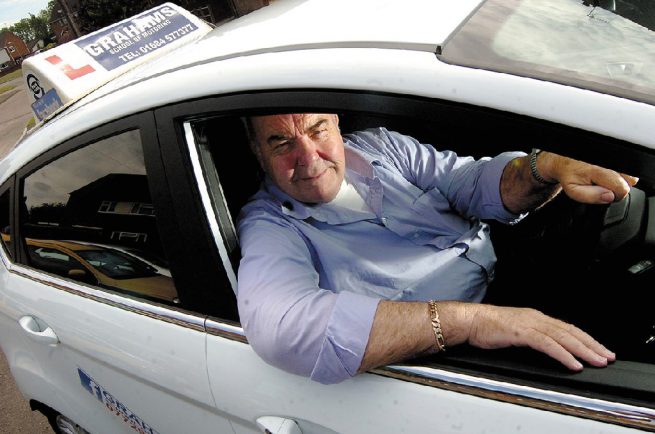
LAST week marked the 80th anniversary of the driving test being introduced in Britain and more than 50 million exams have now taken place since that date. To celebrate the motoring milestone, Observer chief reporter Jonny Bonell caught up with experienced instructors and drivers in Malvern to see how times have changed.
“THE DRIVING test has come a long, long way. For people to pass now they need to be more capable of driving than they used to be.”
That was the assessment of Graham Rhodes, of Graham’s School of Motoring, who has been teaching people to drive in and around Malvern for more than 30 years.
The semi-retired 65-year-old, who was originally going to call his business ‘On The Road With Rhodes’ before a change of heart, recalled a time when the test was all about manoeuvres in the vehicle – rather than independent driving.
“When I first started you did an emergency stop, a hill start, three-point turn, reverse around the corner and pull out from behind a parked vehicle and basically that was your driving test,” Graham, whose pass total is in the thousands, said.
“The examiners never used to speak to you or acknowledge you as a driving instructor.
“They just gave you a nod – sometimes – as they walked past but over time it has developed quite well.
“The art of this job is they (learners) will make mistakes, they will drive on the pavement now and again and they will put your heart in your mouth.
“If they could drive they wouldn’t need me so there is no point getting frustrated with them because that doesn’t solve any problems at all.”
The driving test became compulsory on June 1, 1935, when there were just 1.5million cars on the nation’s road but more than 7,000 people killed in related incidents.
Introducing the exam reduced the number of deaths by 1,000 within the first year.
Last year there were 35million vehicles licensed for use in the UK and 1,700 people were killed on Britain’s roads.
Driving stalwart Ilfa Jones, of Malvern, picked up her licence in the 1950s when she was training to be a midwife in London and spoke of the challenges in driving an Austin A40 – a car without indicators – and learning how to use hand signals.
And despite all modern cars being fitted with the electronic signals, the 83-year-old said people failing to use them is one of a number of things which ‘infuriates’ her with modern drivers.
“We were instructed to always indicate where we going when I was learning,” Ilfa added. “Everyone used to be so polite on the roads and never broke the 30 mph speed limit.
“But now, the smallest thing and someone will beep their horn at you.”
Significant changes in the driving test include when candidates stopped being tested on hand signals in 1975, the theory test being introduced in 1996 – six years later a hazard perception element was added to it – and in 2010 a ten minute ‘independent driving’ section was added.
Alastair Peoples, driver and vehicle standards agency chief executive, said: “The driving test has adapted over the years to stay up to date with modern driving, and we continue to keep it under review to ensure it is as relevant and effective as possible.
“We have already made the test more representative of real life driving by requiring candidates to show they can drive safely without constant directions from their examiner.”