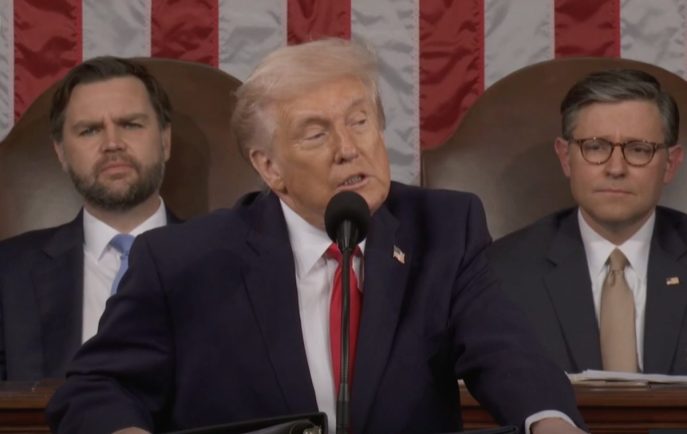
President Donald Trump used a record length State of the Union address to paint a confident picture of a United States, he said, is back on the front foot, at home and abroad.
Speaking to a joint session of Congress in Washington on Tuesday night, the president described what he called “the golden age of America” and told lawmakers that “the economy is roaring like never before”.
At roughly one hour and 47 minutes, the speech was widely reported as the longest modern State of the Union on record, stretching deep into themes that have defined Trump’s second term, economic momentum, border enforcement, crime, and a muscular approach to foreign policy.
A pitch built around confidence, and continuity
Trump’s overall tone was celebratory and forward looking, returning repeatedly to the idea that the country has turned a corner. In one passage, he told the chamber, “our nation is back”, and later argued that “the state of our union is strong”.
For audiences in the UK, the State of the Union is the American president’s annual set piece in front of Parliament’s closest US equivalent, the House and Senate assembled together. In practice, it is part report card, part legislative wish list, and part prime time political theatre, and on this occasion the theatre was unmistakable.
Economic optimism, and bold claims
Trump presented his economic case in broad strokes, emphasising lower inflation, market gains, and renewed investment. He said his administration had driven inflation down and highlighted stock market milestones, as he argued that US confidence was returning.
Some of the most eye catching figures in the address have already been challenged by the Democrats, who say several claims lack supporting public evidence, or need significant context, including assertions related to election fraud and very large investment totals.
Still, the political purpose of the economic section was clear, to reassure households and businesses that the White House sees growth and affordability as central issues, ahead of this year’s midterm elections.
Border security as a centrepiece
Immigration remained one of the most emphatic parts of the speech. Trump told Congress, “We now have the strongest and most secure border in American history,” and claimed that “The flow of deadly fentanyl across our border is down by a record 56 percent in one year.”
He also framed enforcement as compatible with legal immigration, saying, “But we will always allow people to come in legally, people that will love our country and will work hard to maintain our country.”
Honours, guests, and an appeal to national pride
Beyond policy, the address leaned heavily into tributes, awards, and invited guests, a tradition US presidents use to put human stories at the heart of their message. Coverage of the speech noted moments of bipartisan applause, including when Trump welcomed the winning US men’s Olympic hockey team, and highlighted service members and first responders.
That patriotic emphasis was tied to an anniversary theme, as Trump repeatedly referenced America’s approaching 250th year since independence, presenting it as a springboard for what he called a new national chapter.
Foreign policy, strength, and uncertainty
Internationally, Trump spoke in the language of deterrence and leverage, including a warning to Iran and a preference for diplomacy, while insisting he would not allow Tehran to acquire a nuclear weapon.
On trade, he defended tariffs as an engine of domestic strength, even as the policy faces renewed legal and political scrutiny following a US Supreme Court ruling against parts of his tariff programme.
A divided chamber, and a sharp rebuttal
The night also underscored America’s partisan temperature. Reuters described a speech that ranged widely and drew attention for both its length and its political edge.
Democrats offered a formal response led by Virginia governor Abigail Spanberger, who criticised the president’s approach and argued the speech did not address what she called the country’s most pressing challenges.
What it could mean for UK readers
For the UK, Trump’s State of the Union matters less as a legislative timetable, and more as a signal of how Washington wants to be read, by markets, allies, and adversaries. The president’s message was, unmistakably, that he sees momentum on his side, that tougher enforcement at the border is central to his mandate, and that American power, economic and military, is back as the organising principle of his worldview.
Whatever one makes of the sharp domestic arguments around him, Trump used the biggest stage in US politics to offer supporters what they wanted, a confident narrative, a long list of priorities, and a sweeping statement of national ambition.