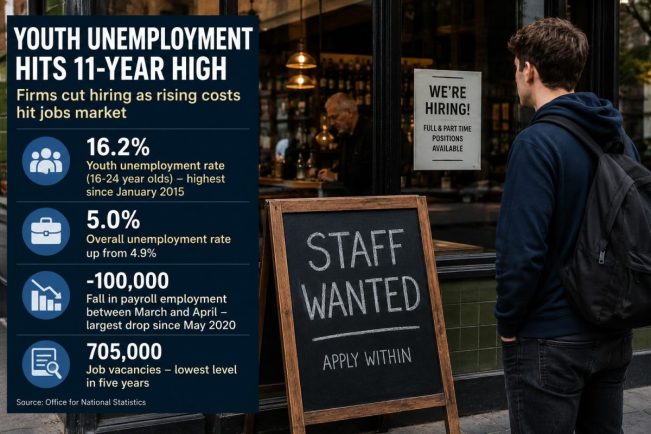
Youth unemployment in Britain has climbed to its highest level in more than a decade, as businesses warn that rising employment costs and a weakening economy are forcing them to cut back on hiring.
New figures from the Office for National Statistics show the unemployment rate for 16 to 24-year-olds has risen to 16.2 per cent, the highest level since January 2015. Overall unemployment also edged up to 5 per cent, while the number of people on company payrolls fell sharply between March and April.
Preliminary tax data showed payroll employment dropped by 100,000 in a single month, the steepest decline since the first Covid lockdown in May 2020. The number of vacancies also continued to fall, reaching a five-year low of 705,000.
Employers in hospitality and retail, sectors traditionally relied upon by younger workers, say higher wage bills and increased employer National Insurance contributions have made recruitment increasingly difficult.
One pub landlord in the Midlands said he had stopped taking on younger staff because the costs had become unsustainable.
“We used to employ several young people, students mainly, for evenings and weekends,” he said. “But trade is quieter now and it’s simply too expensive to hire. My wife and I are working double shifts just to keep the show on the road.”
The hospitality sector recorded one of the sharpest falls in payroll numbers, losing more than 18,000 jobs in April alone.
Young job seekers have also spoken of growing frustration as opportunities dry up.
Ella, 22, from Worcestershire, said she had applied for dozens of entry-level jobs without success.
“Every vacancy gets hundreds of applications,” she said. “You need experience to get a job, but nobody wants to give you that first chance anymore.”
Liam Carter, 19, from Birmingham, said many of his friends were struggling to find work after leaving college.
“A lot of places just aren’t hiring,” he said. “You go into shops or pubs and they tell you they can’t afford extra staff.”
The latest figures also showed wage growth slowing significantly. Average regular pay growth fell to 3.4 per cent in the first three months of the year, the weakest rate since October 2020 during the pandemic.
Economists said the slowdown in wages and recruitment reflected mounting uncertainty across the economy, compounded by rising global tensions and higher energy costs linked to the conflict in Iran.
Liz McKeown, the ONS director of economic statistics, said the labour market remained weak.
“Vacancies are now at their lowest level in five years and unemployment is higher than a year ago,” she said. “Lower paying sectors such as hospitality and retail have seen some of the largest falls in vacancies and payroll numbers.”
Pat McFadden, the Work and Pensions Secretary, said the Government remained focused on tackling youth unemployment despite the deteriorating figures.
“Boosting opportunity and tackling youth unemployment in every area remains our priority,” he said. “Through our Jobs Guarantee we are helping young people into work while engaging employers to ensure they have the skilled workforce they need.”
However, business groups and economists warned conditions could worsen in the coming months as firms face rising operating costs and continued economic uncertainty.
Deutsche Bank economist Sanjay Raja said employers were likely to remain cautious.
“We expect firms to limit hiring over the coming months as cost pressures mount,” he said. “Equally, we expect firms to keep wage rises to a minimum as businesses navigate uncertainty and rising costs.”
Since October 2024, payroll employment has fallen by more than 277,000, according to official data, with steep losses recorded across retail, hospitality, construction and manufacturing.
While inflation is expected to ease slightly in the short term because of lower domestic energy bills, the Bank of England has warned that higher global energy and food prices linked to instability in the Middle East could push inflation above 6 per cent later this year under its worst-case scenario.
Are you a young person struggling to find work? Share your experience in the comments.
Main Image: For illustration purposes only.