MALVERN’s campaign to help Syrian refugees was showcased to the world after a district councillor attended an international conference.
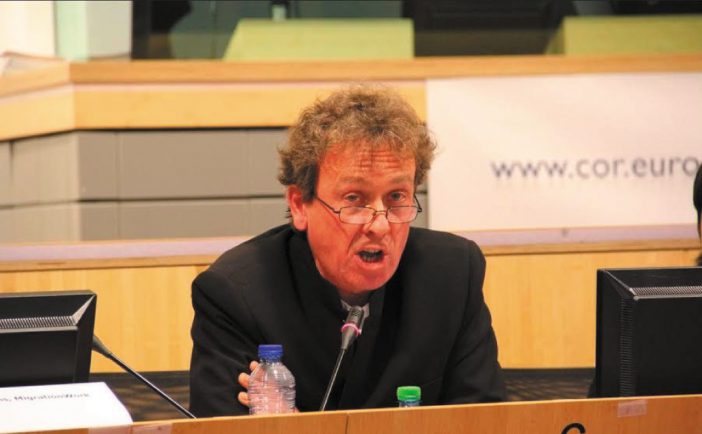
Coun Julian Roskams, who is part of the Malvern Welcomes Syrian Refugee Families group, spoke in front of 200 delegates from all over the world at the event in Brussels, Belgium, last Tuesday (October 20).
The conference was hosted by the European Committee of the Regions and the International Catholic Migration Commission and addressed protecting and welcoming refugees in Europe.
Coun Roskams told the Observer of his personal account of the conference and what he feels needs to be done next.
“I was absolutely delighted to be representing Malvern Welcomes Syrian Refugees at a conference in Brussels, ‘Protecting and Welcoming Refugees in Europe: responding to an unprecedented crisis.’
With almost 200 delegates from 20 or more countries across Europe, Malvern was one of just three UK towns with representatives at the conference (the others being Leeds and Coventry). It is a real testament to the work that we have done in Malvern that we should have been invited by the SHARE network and the ICMC to attend the conference hosted at the EU Committee of Regions.
I was able to tell the ‘Malvern story’ when I sat on a panel that addressed the issue ‘strengthening public and political awareness of refugees’, alongside colleagues from Germany, Czech Republic, Poland, Bulgaria and Madrid.
It was heartening and inspiring to hear of the experiences and many challenges of community groups, NGOs, and municipalities across Europe. A lot of it was familiar –we face many of the same challenges. But it was chastening to hear from countries in the south and east of Europe that are having to cope with the immediate demands of a massive and unplanned influx – as well as planning for resettlement. It became clear there is no single correct answer and that every country will have its own ways of dealing with the challenges.
We heard too from other key players – the EU Commission, the Committee of the Regions, the UNHCR, a Swedish MEP. And most critically, we heard from the refugees themselves – their experiences of crossing Europe, settling in host countries in Belgium, Netherlands and Germany – where the welcome has been both overwhelming and effective. It was a really positive story.
The most moving testimony came from a Syrian woman who tearfully thanked delegates for their efforts – as she reported how that same day her home city had been subject to sustained bombing.
The most important lesson for me – though it is just one of many that I have come away with – is that the refugee crisis is only a crisis for the refugees; for us it is a challenge – and it is one that we can and we must meet. And this cannot be done by one agency alone. This is beyond the EU, national governments and municipalities. This is a task for which we are all responsible – and which cannot succeed without proper and effective partnership between Government, NGOs and civic society.
It is civic society that will create the welcome, that will embrace the refugees, and be responsible for their integration. Government has to accept we are key partners and not bit-part players. We will no longer accept it.
So, it is time for Government both nationally and locally to start to engage with those who are ready and willing to help. It is not a time to play politics.”