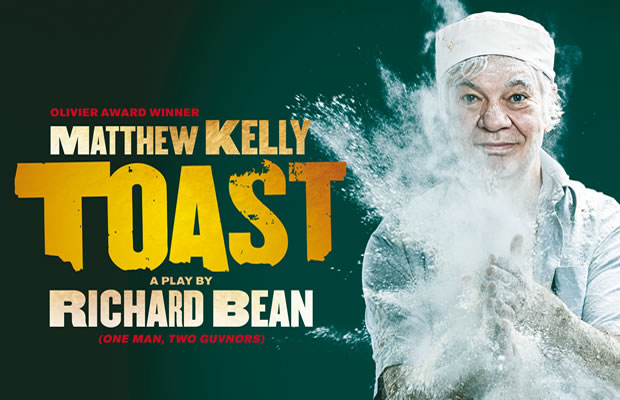
Toast by Richard Bean – Reviewed by Lee Farley
Malvern Theatres
23 Feb 2016
Richard Bean writes original, contemporary drama (‘Pitcairn’, ‘The English Game’) and creates updated adaptations of comedy classics (‘One Man, Two Guvnors’, ‘The Hypochondriac’). He’s interested in social systems and British identity – what it means to live and work in an often incomprehensible environment. ‘Toast’ was his first play to be produced, at the Royal Court in 1999. It’s set in the 1970s and attempts to explore identity (male, working-class identity specifically – the only woman in the play is “our lass” on the phone). This revival is a curio – a sketch in progress for the playwright who went on to delve further into his ideas and create much more successful work.
We’re in the scuzzy break room at a bread factory in Hull. The bin overflows with used tea bags, the walls are stained, the tables and chairs are functional and worn. We meet seven men who work at the factory, from Nellie who’s been there 45 years, to Lance who’s a student on his first temp shift. We learn a lot about shift patterns and the inner workings of making loaves. There’s not much in the way of plot, Richard Bean is more interested in the men and their relationships. He states in an interview in the programme that he’s “interested in entertaining an audience rather than changing the world”. The problem is that entertainment is very subjective – if your objective is to make people laugh but they don’t share your sense of humour, there’s not much substance left.
Eleanor Rhode’s production emphasises the comedy and old-fashioned theatrical business. There’s plenty of innuendo, chasing each other round the table and over-excitement at the idea of being “on a promise”, but nothing complex like subtext or character development. The performances are surface deep only. I was reminded more of 70s sitcoms like ‘On The Buses’ than working class drama like David Storey or Alan Sillitoe. I couldn’t detect anything relevant, contemporary or political. Bean certainly hasn’t “changed the world”.
The performers aren’t asked to do much other than stick to the traditional comic framework and rhythm that theatre has been peddling for the past 50-60 years. Set-ups are obvious, gags are ancient. Even for a nearly 20 year-old play, it’s surprising that Bean relies so heavily on outmoded, unfashionable patterns and structures. Matthew Kelly is quietly compelling as the old-timer Nellie, but even he resorts to ‘comedy sitcom mode’ in the second half when he’s on the phone to a colleague’s wife. The rest of the ensemble struggle to raise their game above the demands of the format – it’s permanently apparent that they’re acting. Richard Bean is trying too hard to keep us “entertained”.
‘Toast’ is conservative and inconsequential. Richard Bean’s stated aim to entertain his audience is achieved in his later works, but is sadly lacking here.