WORKS to repair the historic medieval Powick Old Bridge kicked off today (Monday, July 29).
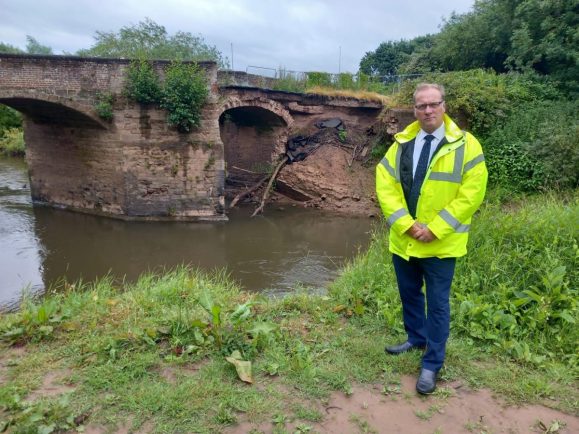
Powick Old Bridge is famous for its roles in both the first and last English Civil Wars – Battle of Powick Bridge (1642) and Battle of Worcester (1651). Built before 1447, it is a scheduled ancient monument with incredible historical significance for Worcester and the county.
The car park next to Hams Way Bridge has closed and its public right of way have been diverted in the lead up to the works.
On Monday (July 29) the team began to establish the compound ahead of the creation of the working platform on the upstream side of the river.
The purpose of the working platform is to safeguard the collapsed area of the wingwall from further damage, and to allow the arch and abutment to be properly inspected.
The temporary works will be followed by detailed design of a permanent reconstruction, which will require further approvals ahead of final works next year.
The temporary platform will prevent water from entering the arch so that work can take place, and if the river does flood water will be diverted over the top of the platform.
This approach will also lead to a large proportion of the original stonework being reclaimed from the river bed.
The wing wall will need to be completely taken down as part of the repair process, however, the rebuild will use as much of the initial stone and brick as possible.
Councillor Marc Bayliss, Worcestershire County Council’s Cabinet Member with Responsibility for Highways and Transport said: “I’m delighted that the first phase of repair work is about to start on Powick Old Bridge.
“Hopefully the installation of the temporary platform will reassure people that we are working hard to reinstate the bridge to its former glory.
“The platform will protect the damaged section of the bridge from losing more material and prevent water from entering the arch so restoration work can take place.”
Worcestershire County Council have had to work with key partners including Natural England, Historic England and the Environment Agency to establish the restoration plans.
The structure is within a Site of Special Scientific Interest (SSSI).